Mabel helped 35 ACO REACHs submit >95% SDoH data reporting to maximize earn back
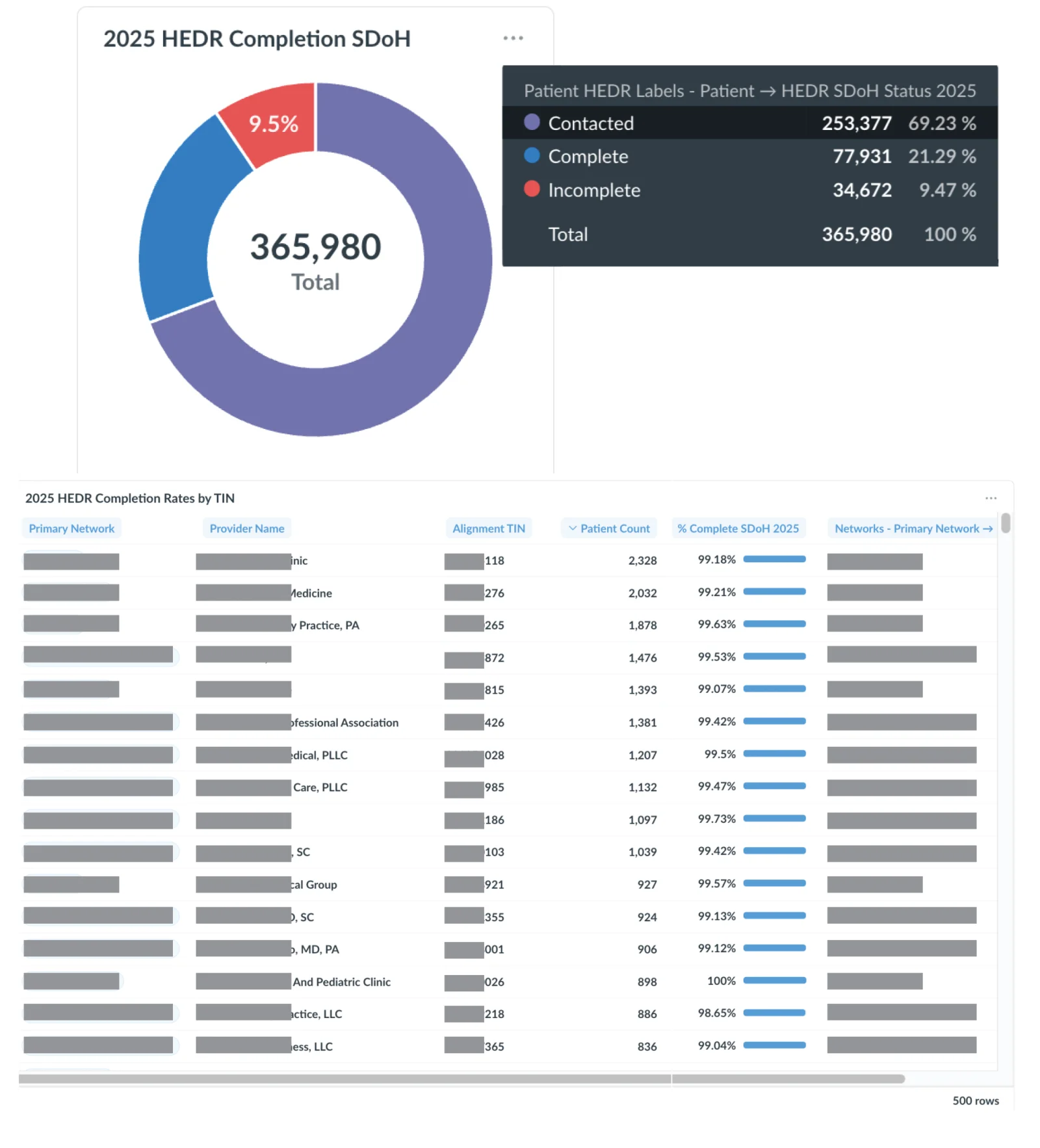
The results speak for themselves: in PY25, all of Mabel's ACO partners achieved nearly 100% SDoH reporting, realizing a 6X–19X ROI.
Complete SDoH reporting helps ACOs maximize their Quality Withhold Earn Back
In PY25, under Data Reporting (now Upstream Drivers of Health), CMS required ACO REACHs to collect Social Determinants of Health (SDoH) data on aligned beneficiaries to maximize their Quality Withhold Earn Back. To qualify, ACOs must make a good faith attempt to collect SDoH data from every aligned beneficiary, worth up to 0.2% of the ACO Benchmark—a meaningful financial opportunity.
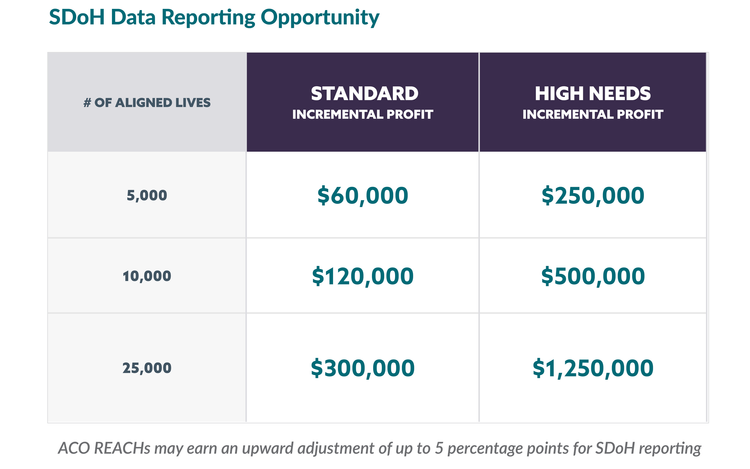
In PY 2026, REACH ACOs may earn a 0%–5% bonus added to their Initial Quality Score for submitting beneficiary-reported upstream drivers of health data.
SDoH data collection is high-stakes, but fragmented
Despite the financial opportunity, running a high-performing SDoH collection effort in-house is challenging for several reasons.
Most practices haven't collected SDoH data at all.
Unlike demographic data, which most EMRs already capture, SDoH data collection is largely absent—few EMRs offer built-in survey tools, and most patient workflows don't account for it.
CMS only accepts three approved screeners—with no hybrid responses.
Each beneficiary's responses has to come entirely from one of three CMS-approved screening instruments, with no partial credit for blended submissions.
Fragmented EMRs make aggregation difficult.
With providers spread across a network of disparate EMRs, standardizing and consolidating SDoH responses into a single CMS-ready submission file is a manual, error-prone process.
ACO REACHs require a multi-channel, technology-driven solution to streamline the SDoH data reporting collection and submission process.
Mabel handles SDoH data reporting requirements from beginning to end
Mabel is a technology-enabled SDoH data reporting solution built for ACO REACH organizations. The platform automates and centralizes beneficiary outreach, response collection, and CMS-ready data submission, replacing the manual processes that make in-house SDoH collection difficult to scale.
In PY25, Mabel partnered with 35 ACO REACHs to manage SDoH data collection and submission across nearly 366,000 beneficiaries and more than 500 providers. Because no single approach works for every organization, Mabel deployed a combination of tools—some supporting providers in collecting SDoH data at the point of care, others reaching beneficiaries directly via email and mail to close the gaps. NOTE: Mabel does not reach out to deceased individuals even if they are included in the SDoH denominator.
Mabel's PY25 SDoH Results
Mabel's approach
Survey deployment
Mabel deployed direct-to-patient SDoH surveys via email and mail, plus in-clinic surveys providers could hand to patients at the point of care—giving every aligned beneficiary a compliant way to respond, even without an EHR-integrated workflow.
Data aggregation & crosswalking
For providers collecting SDoH data in their EMR, Mabel ingested SDoH responses across every EMR format in the network and crosswalked them into the CMS submission template, removing the burden of manual standardization.
Dashboard tracking & submission
The Mabel Dashboard gave the ACO real-time visibility into completion rates by provider and patient, so the team could focus outreach on the practices that needed the most support.
100% SDoH reporting can be achieved through compliant email and mail outreach—even when beneficiaries don't respond. Mabel's outreach met CMS's good-faith-attempt standard for every aligned beneficiary, not just those who completed a survey.

With more than 20 TINs on different EMRs, we were struggling to figure out how to even start collecting SDoH data across our network. Mabel's direct-to-patient email and mailed surveys, along with in-clinic surveys that we could give our providers, allowed us to reach nearly 100% SDoH completion.
Let's get started.
It's not too late to capture 100% SDoH data reporting. Contact us to request a demo.
30 minutes · No commitment